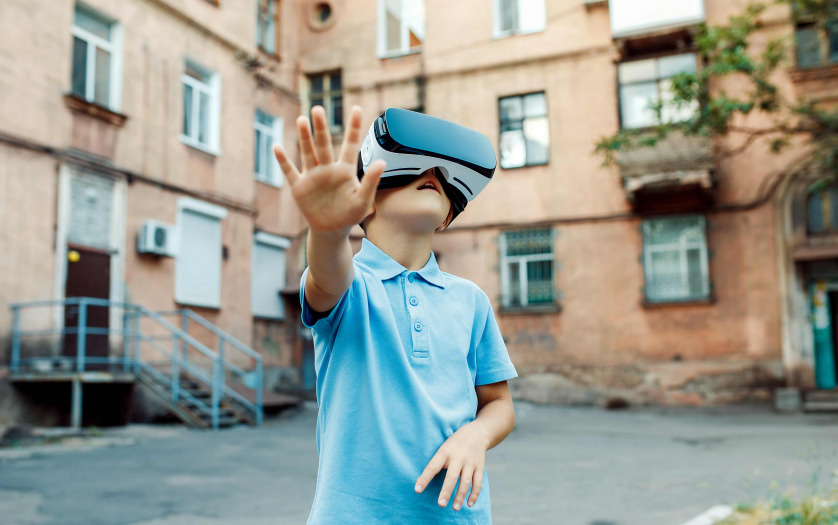
A recent study conducted by researchers at the Center for Autism and Related Disorders (CARD) found an immersive virtual reality training environment to be effective in teaching street-crossing skills to children with autism.
There are challenges to teaching safety skills in clinical settings. Safety skills learned in contrived settings may be difficult for individuals with autism to apply in the natural environment, which is critical for a potentially life-saving skill. While safety skills may generalize more easily if taught in the natural environment, these environments, such as a street crosswalk, may be hazardous.
“Virtual reality may offer the advantages of both contrived and natural environment training settings,” said Dennis Dixon, Ph.D., Chief Clinical Officer. “Immersive virtual reality technology can be used to create a safe and realistic environment that closely matches the natural setting.”
Study participants included three children with autism, ages 4 to 10 years old. The immersive virtual reality environment consisted of 360-degree videos, recorded on streets in the participants’ community. The participants interacted with these videos using a head-mounted device. Behavioral teaching strategies, including prompting, reinforcement, and corrective feedback, were used to teach the participants to identify whether it was safe to cross the street in the virtual environment. Ultimately, all three participants mastered this skill in both the virtual environment and on real streets in their community.
The current study found an immersive virtual reality training environment to be effective in teaching children with autism to identify when it is safe to cross the street. The technology used in this study may be a practical option to implement in clinical settings because it was relatively cost effective and required essentially no software development.