“Before, I stayed at home. Now I am happy to go back to school,” says 15-year-old Boubacar Barry. This return marks a decisive turning point in his life. For nearly nine years, he lived with severely limited mobility, which restricted his movements and kept him on the margins of school life.
Like Barry, many people in Senegal face limited access to assistive technologies—a major public health and social inclusion challenge. These technologies include essential devices such as prostheses, orthoses, wheelchairs, glasses and hearing aids. They help restore functional abilities, prevent complications, promote inclusion and strengthen autonomy. In their absence, physical limitations can lead to long-term exclusion, particularly for children, affecting access to education, employment and social participation.
According to the latest available national survey on assistive technology, conducted in 2021, 62.6% of people in need of such devices did not have access to them, mainly due to cost, geographical inequalities and stigma. This finding highlighted the need to strengthen national interventions to improve access to assistive technologies and reinforce rehabilitation services within the health system.
World Health Organization (WHO) emphasizes the central role of scientific data and health innovation in designing more equitable and effective solutions. It is in this context that Senegal launched the Bokk Naa Cii project (“I belong” in Wolof) in 2023, with support from WHO, ATscale and UNICEF. The initiative aims to expand access to assistive devices, strengthen the policy and institutional framework for rehabilitation, and raise awareness within communities.
To date, almost 30 000 people have benefited from assistive technology services or products—including assessments, follow-ups and device provision—including 7000people who have been equipped with appropriate devices, with particular attention to women and children.
Barry is among the 383 people who have received a prosthesis through these interventions. After losing his leg in Guinea due to a snake bite in his native village of Télimélé, he was later taken to Dakar by his aunt following the death of his parents. For several years, he lived with limited mobility, intermittently dropping out of school and begging.
Reflecting on that period, Barry says: “I was sad all the time. I thought I would never walk like other children again.” His aunt, Adama, shares this view: “He sometimes refused to go outside. He was ashamed. Even going to fetch water was a struggle,” she explains.
Boubacar’s life changed when a video shared on social media drew the attention of the authorities. The Ministry of Family, Social Action and Solidarity then mobilized the National Orthopedic Appliance Centre (CNAO), which provided care for him with support from the Bokk Naa Cii project. “Every child has the right to hope. For Boubacar, the prosthesis was not only a medical device, but the key to returning to school and reintegrating into society,” says Dr Seydina Ousmane Ba, Director of CNAO.
WHO’s support to the Senegalese government is part of a systemic approach to strengthening the health system. It includes the provision of orthopedic equipment and components—initially valued at US$ 110 000 within a broader investment exceeding US$ 450 000—as well as training at the national level. To date, 61 rehabilitation professionals have been trained, and 13 centres and five optical units receive ongoing support, as part of a national target to reach 50 000 people.
WHO emphasizes the sustainability of these gains. “Our goal is to ensure that assistive technologies are no longer a luxury reserved for a few but become an effective right for all who need them,” says Dr Michel Yao, WHO Representative in Senegal.
Progress is also visible at the national level. In 2025, 731 wheelchairs, 1639 orthoses, 1385 pairs of glasses, and 85 hearing aids were distributed. In addition, 19 924 people were screened for eye health, including 218 children, improving early identification of needs and referral to appropriate services.
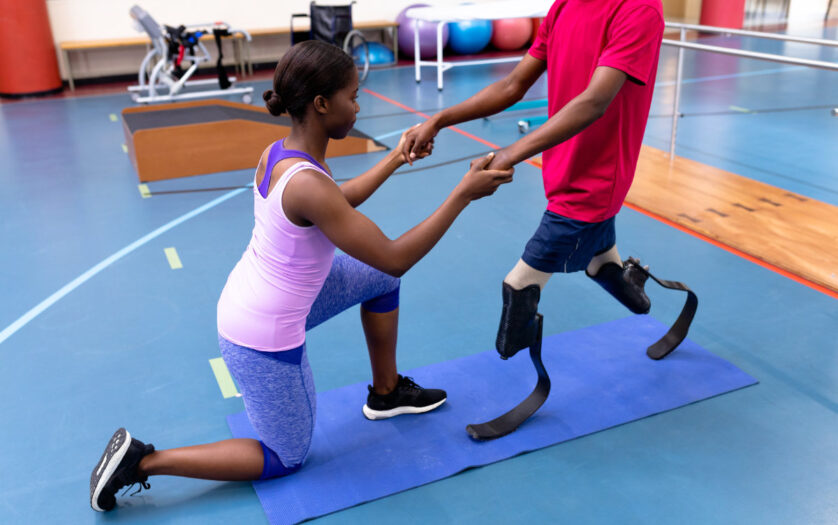
After several assessments and rehabilitation sessions, Barry gradually learned to walk again. Over time, with the support of specialists, he regained confidence and independence. He was able to return to school, where he gradually adapted with the support of his classmates.
Today, at home and at school, the change is visible. Boubacar takes part in daily activities and interacts with his peers. His aunt observes this transformation: “I thought he would remain dependent his whole life. Thanks to this prosthesis, he has regained a normal life,” she says.
When asked about his future, Boubacar replies with determination: “My dream is to study business and succeed in that field.”