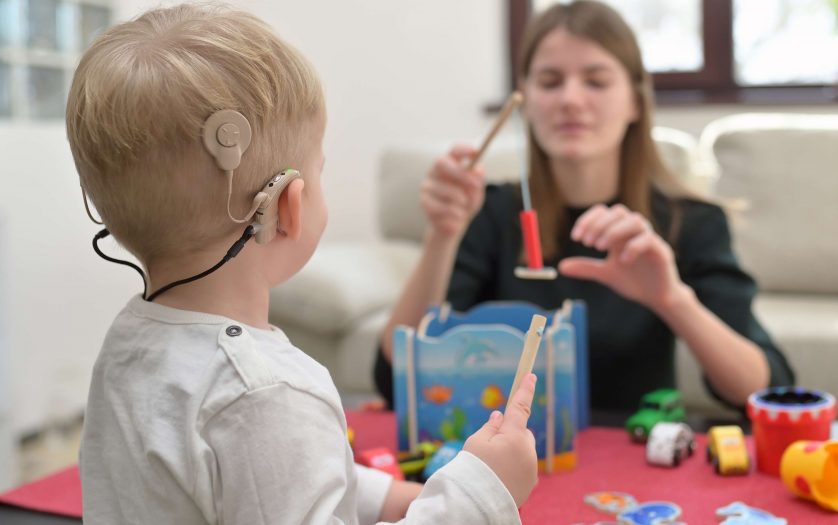
Cochlear implants are a groundbreaking technology that has changed the lives of many people living with severe to profound hearing disability.
University of Sydney School of Biomedical Engineering researcher, Dr Greg Watkins, hears with the assistance of two cochlear implants after experiencing profound deafness in both ears following a 30-year career as an electrical engineer.
Despite his profound deafness, with the help of his cochlear implant he has been able to complete a PhD in biomedical engineering.
Dr Watkins’ desire to help others living with deafness, his personal experience and career in engineering, motivated him to research cochlear implants.
Now, his new paper has analysed the accuracy of predictions for cochlear implant outcomes with a view to further improving their performance in environments with lots of background noise.
Published in Ear and Hearing the paper presents a new method for the prediction of speech perception for individual recipients, providing a methodology that could make patient trials more efficient, potentially leading to implants that are personalised to an individual’s listening capability.
“My hearing deteriorated over a number of years and even with powerful hearing aids I had great difficulty having a conversation,” said Dr Watkins, who received his doctorate earlier this month.
“Cochlear implants have helped to restore my hearing and stay connected socially and professionally
“Cochlear implants often provide near-perfect speech perception in quiet conditions, but hearing can still be improved in noisy environments, like in cafés or near traffic, compared to having no hearing loss.
“Evaluation of new sound processing ideas and testing them on recipients is a lengthy process.
“We have developed a metric which reliably predicts cochlear implant speech intelligibility in a range of conditions, allowing for more sound processing ideas to be tested.
“We took existing hearing test results for cochlear implant recipients and, using the output signal to noise ratio (OSNR) metric, accurately predicted how well they would hear in a range of quite different listening conditions.
“Potentially, this metric could be used to develop configurations which are customised to an individual recipient’s unique hearing capabilities.”
The study was conducted under the supervision of Head of School of Biomedical Engineering, Professor Gregg Suaning and Dr Brett Swanson, a researcher at Cochlear Ltd.
Professor Suaning said the research could lead to better outcomes for implant recipients.
“Cochlear implants are already extraordinary devices and have transformed the lives of hundreds of thousands of people world-wide,” said Professor Suaning.