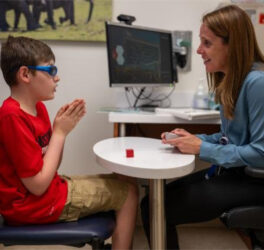
Families of children with Autism who live in rural areas might receive better and more equitable access to early intervention services using telehealth technology, according to a recent study led by two University of Maine professors.
Studies have shown that early intervention is key to improving developmental and educational outcomes for children with autism. However, rural families often have to travel great distances for such services, which are more readily available near population centers. Telehealth is one option for addressing this problem.
“Increasing the availability of evidence-based interventions through telehealth may be a valid solution to closing the gap between service demand and availability in rural and underserved areas,” the study says.
Led by assistant professors of special education Deborah Rooks-Ellis and Sarah Howorth, the study looked at what happened when a state program provided an early intervention service to families via telehealth. The service was the parent-Early Start Denver Model, a relationship-based intervention that works with caregivers and children, targeting multiple skills within the child’s daily routine designed to strengthen and support development. Over a 12-week period, an experienced state interventionist worked with families on P-ESDM skills during 90-minute videoconferencing sessions.
Parents who participated in the study showed a better grasp of the intervention strategies and reported satisfaction with how easy it was to access services through telehealth.
In addition, caregivers generally were pleased with the gains made by their children. The researchers found statistically significant changes in children’s autism symptoms pre- and post-intervention in areas such as communication, social reciprocity, and repetitive and restricted behaviors. For example, following intervention, “parents reported their child shared enjoyment or excitement with others.” Children also “experienced problems in communicating with others less frequently” and “certain rituals or routines were reported to have less impact on… daily functioning.”
Although further research is needed, the authors conclude that: “Providing intervention using telehealth as a service delivery model may alleviate higher costs of services associated with travel time, distance between families, and provider shortages.”