You could hear the confidence in their voices. Sometimes it blended with shock, uncertainty, anger, pain, disbelief, frustration or even humor. But they spoke up for themselves—and others like them—confidently.
These were speakers all living with a rare disease, and they took turns sharing their personal experiences and health stories at a recent Rare Disease Day event held at The University of New Mexico Center for Development & Disability (CDD). The gathering helped to raise awareness, facilitate networking, encourage problem solving, support advocacy efforts and build community around rare diseases—a reality faced by more New Mexicans than many may realize.
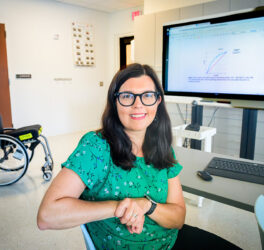
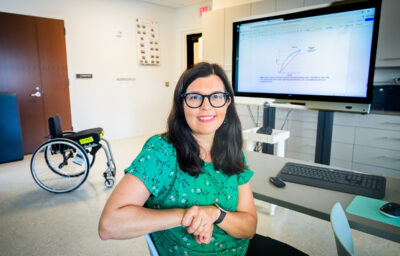
Rare diseases are not that rare, said CDD executive director Marcia Moriarta, PsyD, who organized the event. Moriarta is also a clinical psychologist, professor in the UNM School of Medicine Department of Pediatrics and director of CDD’s Leadership in Neurodevelopmental Disabilities program.
“I think that when you take it in the context that they’ve identified 10,000 different so-called ‘rare diseases,’ they’re not rare,” Moriarta said. “They’re just diverse.”
A disease or health condition is generally considered rare if it affects fewer than 200,000 Americans, according to the U.S. Orphan Drug Act. The U.S. Food and Drug Administration states that more than 10,000 rare diseases affect a combined 30 million Americans, with roughly half being children.
“One in 10 New Mexicans has a rare disease,” according to New Mexico Rare Disease, a coalition of researchers, health care providers and experts from across New Mexico, including UNM.
Examples of rare diseases, according to the National Organization for Rare Disorders, include Bell’s palsy, ocular melanoma and sickle cell disease.
It’s not just about the economics of health care and being able to deliver more efficient treatments. Today is about building a community of people who are all having different experiences with things, and it’s actually lovely. This is good for people.
– Marcia Moriarta, PsyD, Executive Director, UNM Center for Development & Disability; Clinical Psychologist; Professor, UNM School of Medicine Department of Pediatrics & Director, Leadership in Neurodevelopmental Disabilities Program
“It’s so important that we hear the voices of people who are living with these experiences,” Moriarta said.
During an open discussion at the event, the guest speakers detailed the health challenges that come with having a rare disease, such as being misdiagnosed or diagnosed late, making frequent doctor visits, being subjected to other people’s assumptions or not being believed about their symptoms and struggles.
“This is something that could affect a lot of us, and you don’t necessarily know it until you’re in that space,” Moriarta said. “Wouldn’t you want to know there would be a place to go for resources and support? And right now, I think you see that this is a community of people that’s built it for themselves.”
Because there are so many rare diseases, they are probably not top of mind for many health care providers, and this can lead to a patient not getting the treatments or other help they need, Moriarta said.
“So, it has a real negative impact on your ability to access care,” she said.
It’s true that health providers are trained to search for the most common cause of a health condition, Moriarta said.
“We’re all trained to identify the most likely reason someone’s presenting with a certain set of symptoms, and that’s a statistically valid practice. The odds are, you’re going to fall in that range. But then the downside is when it doesn’t fit, you’re wrong,” she said.
Having a health condition that doesn’t fit common expectations can make someone feel isolated. In fact, the rare disease community has adopted the symbol of a zebra, representing the uniqueness of each person and each rare disease.
“Every zebra has its own unique pattern of stripes,” Moriarta said.
She hopes that more health providers can be trained to recognize the experiences of patients of all stripes.
“It’s probably impossible to train somebody to know 10,000 different potential diseases, but what is a mechanism or what is a way to have your awareness such that it’s not outside the realm of possibility?” she said.
Further, Moriarta thinks individuals with rare diseases, including New Mexicans, would benefit from more efficient and effective delivery of health care—which can hopefully be achieved through more awareness and advocacy.
Meanwhile, every day, the CDD is doing what it can, like helping build community for individuals who may not have a voice or someone to turn to, Moriarta said.
She added that she is already looking ahead to Rare Disease Day next year and hopes to make the next event more visible and even more meaningful.
“It’s not just about the economics of health care and being able to deliver more efficient treatments,” she said. “Today is about building a community of people who are all having different experiences with things, and it’s actually lovely. This is good for people.”