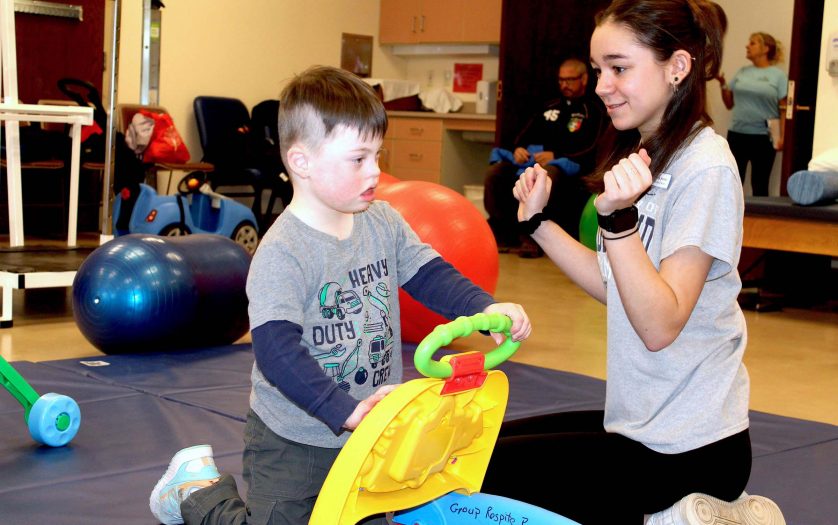
Looking to address a “serious shortage” of specialists to work with some of the youngest children at risk for developmental disabilities in the state, the University of Rhode Island College of Health Sciences is offering a certificate program in Early Intervention to undergraduate students across the university.
The program prepares students to work with families of children ages birth to 3 who have or are at risk for developmental disabilities. Students will gain the knowledge and skills needed to successfully work with families and other health professionals to promote optimal child development and functioning in the child’s home.
“In Rhode Island, there is a serious shortage of early intervention specialists, so we have a wait list for families who are in need of services,” said Casey McGregor, assistant professor in the Department of Human Development and Family Science. “Families are supposed to be seen for their initial EI evaluation no more than45 days of their referral, and it’s exceeding that in many cases. So, in collaboration with the Executive Office of Health and Human Services and other key stakeholders, we created this early intervention certificate at URI so we can streamline a highly qualified workforce directly into the state.”
Completing the certificate courses will allow students to be deemed “qualified personnel” by the Rhode Island Executive Office of Health and Human Services, and allow early intervention facilities to hire certificate holders as an Early Interventionist II on a provisional basis. After successfully completing 1,000 supervised work hours and the initial probationary review, the status of Early Interventionist II would become permanent. The higher level of interventionist will also allow workers to bill Medicaid at a higher level, helping retain the critical health care workers in the profession.
The Certificate in Early Intervention, which is open to all URI students, consists of five courses for a total of 16 credits, and is designed to be completed in as little as one academic year. It is also recommended that students in the certificate obtain an internship in early intervention, providing the opportunity for students to apply and reflect on their skills and knowledge in an actual early intervention setting. Internships in early intervention can be counted toward the required 1,000 supervised work hours needed to secure the Early Interventionist II title.
Any infant or toddler who has a developmental disability or is at risk of one qualifies for early intervention services from the state. The intervention can include services from health personnel from such disciplines as an occupational therapy, speech pathology, physical therapy, communication therapy, and more, to help the child with day-to-day activities.
“Early intervention captures a whole umbrella of people with different specializations. Any student who is part of the College of Health Sciences, specifically, is an ideal candidate,” McGregor said. “The majority of services take place in the home, so early intervention is really family-centered. It is not a program just for the child; it’s for the entire family. The ultimate goal of all early intervention staff is to help children and their families thrive whenever there is a disability or risk for developing a disability.”