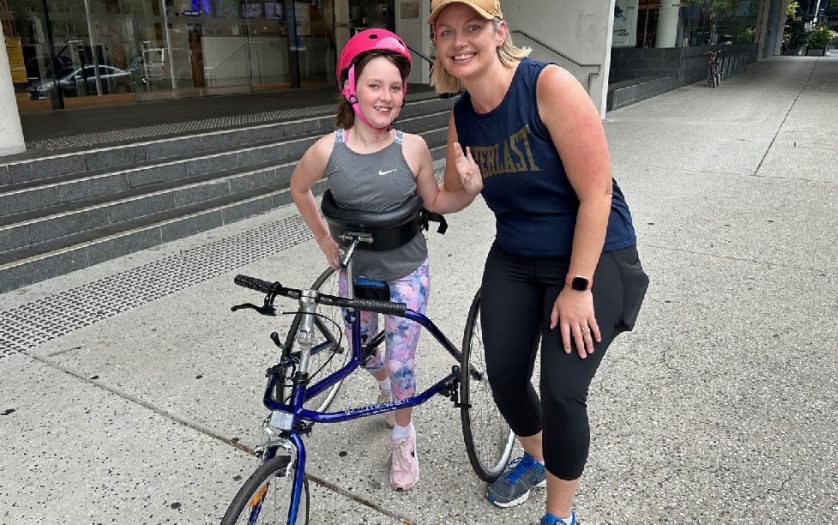
Children with cerebral palsy (CP) have reported significant gains in cardiovascular fitness and mobility after taking part in a landmark research project led by The University of Queensland.
Dr Sarah Reedman, a research fellow at UQ’s Queensland Cerebral Palsy and Rehabilitation Research Centre, is leading the Run4HealthCP program which enables participants with walking difficulties to use a frame to run.
“Young people between the ages of 8 and 21 years were recruited to take part in a 12-week randomised Frame Running trial, a sport tipped to be included in the Brisbane 2032 Paralympic Games,” Dr Reedman said.
“The improvements we’ve found so far in the clinical trial have been really interesting and across a number of different areas of health and wellbeing.
“We have seen that the athletes can not only run for longer, but their heart rate also returned to normal more quickly, which is really important because it shows the heart is healthy.”
CP is the most common physical disability in childhood with around 600 children diagnosed in Australia every year.
People with CP have a 3-fold increased risk of dying from cardiovascular disease, compared to the general population – a statistic that hasn’t changed in 30 years.
The project uncovered quality of life benefits too.
“We found the participants could walk faster which shows we could potentially improve efficiency of movement,” Dr Reedman said.
“It would make a big difference to people’s quality of life because walking is very taxing on the body for people with CP, so if they’re using less energy, they’ll be less fatigued.
“It was also interesting to see people noticing the positive impact of exercise on their physical functioning and ability to do things more easily.
“High intensity exercise is often a new experience for people with high support needs because physical activity is usually inaccessible for them.”
Run4Health, which involves two 60-minutes sessions a week, was initially offered to 12 participants, but has expanded to over 100 with the help of a Medical Research Future Fund (MRFF) grant.
Researchers will also be able to expand the study to include assessments of bone density and gross motor function, and will operate across six sites in Brisbane, the Gold and Sunshine Coasts, Cairns, Sydney, and Perth.
Funding has also been provided by the Children’s Hospital Foundation, and the Dr June Canavan Foundation.
For applications to participate in the trial, go to https://qcprrc.centre.uq.edu.au
The work is carried out in collaboration with The University of Sydney, Australian Catholic University, Curtin University, Queensland’s Children Hospital, Sydney Children’s Hospitals Network and Healthy Strides Foundation.