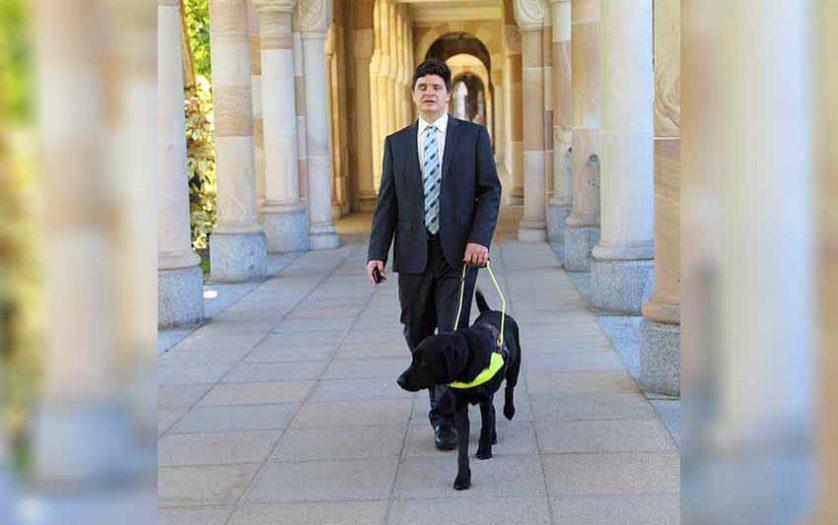
Paul Harpur wears many hats. He’s a lawyer, a company director, a former Fulbright Scholar, a Paralympian and anAssociate Professor at The University of Queensland Law School.
He is also blind and is passionate about disability inclusion.
“Nearly 1 in 5 Australians have some form of disability,” Dr Harpur said.
“Disability inclusion strategies at higher education institutions could play a key role in promoting inclusion for these nearly four million people.”
Dr Harpur, who lost his vision after a train accident at the age of 14, is now in the perfect position to effect change.
He chairs the UQ Disability Inclusion Group and his Fulbright Scholarship allowed him to research disability inclusion at the Harvard Law School.
“I dream of a world where it is no longer about ‘them and us’, instead we talk about just ‘us’,” he said.
As UQ celebrates inclusion and student belonging as part of Teaching and Learning Week 2021, Dr Harpur said he believed universities should be a model for the broader community for disability inclusion.
“Universities can become disability champions where there is institutional support on diversity and inclusion,” he said.
“At UQ, we have such support.
“Inclusion at the University is all about teamwork, and this is reflected in the industry and university level awards we receive.”
Dr Harpur said in the past five years there had been a steady increase in the number of undergraduate students with a disability studying at UQ.
The University’s Disability Action Plan 2020 Annual Report also showed a more than 41 per cent increase in students engaging with disability support services provided by the University.
“UQ is championing disability inclusion and striving to be the university of choice for persons with disabilities,” he said.
Dr Harpur was recently awarded an Australian Research Council (ARC) Future Fellowship to investigate how the higher education sector can better support people with disabilities to transition from economic exclusion to work.
“This is a significant issue because just over 47 per cent of people with a disability are unemployed,” he said.
Considering Dr Harpur’s many achievements, it’s no surprise his hopes for the future are also ambitious.
“UQ is moving from being a disability confident organisation to becoming a disability courageous university,” he said.
“We are well on the way to realising this dream.
“K-12 schooling is producing great students with disabilities, UQ is welcoming them and leading the way in how they can be employed and succeed to fulfil their potential.”