Top of page
Technology

Kazakh engineers developing Braille tutoring device

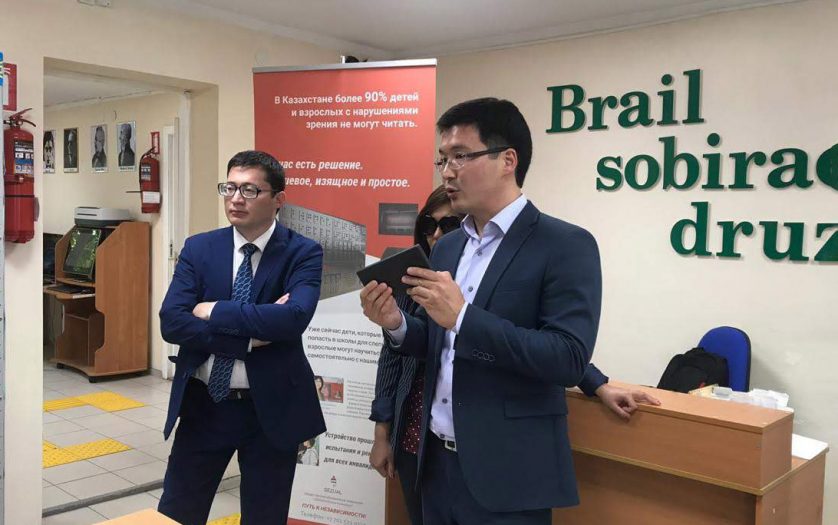
SEZUAL partner Dastan Sagynali (R) while demonstrating Sezual’s Braille self-tutoring device at School
Photo: Photo credit: Sezual project

The Kazakh engineers of the Sezual project started raising $60,000 to produce and provide 40 self-voiced Braille tutoring devices for Kazakh school children with vision disabilities.

According to the Kazakh Ministry of Labor and Social Protection, Kazakhstan has 85,900 people with blindness, and less than 10 percent learned to read in Russian.

The Braille device can teach students the Braille alphabet in just three months, and it is very important for children with vision disabilities during the COVID19.

Presently, the Sezual’s self-voiced Braille learning device is the only ST-KZ certified device that can teach the Kazakh alphabet in Braille script, the Astana Times reported.

“We will be glad if deep-pocketed sponsors decided to support the project. It was a long-enduring effect. The Kazakh language is our state language. Abdilda Shamenov started this initiative to support the state language and the image of the country. The founder of our company Galimzhan Gabdreshov and commercial director Dastan Sagynali have supported this initiative,” said Nurbek Yensebayev, Sezual project.

In addition to Kazakh, children can learn to read in many other languages with the device. It can also teach children to read Russian, English, and Chinese, among other alphabets and scripts.


You might also like

Close up of a woman hand on adaptive mouse using computer Close up of a woman hand on adaptive mouse using computer

Program expands assistive tech access for persons with disabilities

Persons with disabilities in Western Australia will get better access…

Close up of a kid hand on adaptive mouse using computer Close up of a kid hand on adaptive mouse using computer

Solomon Islands expands AT support for children with disabilities

When thinking of schoolchildren, you would imagine them as being…

Nihal Patel, a second-year medical student, in the The Workshop in James Branch Cabell Library Nihal Patel, a second-year medical student, in the The Workshop in James Branch Cabell Library

Student uses 3D printing to create custom assistive devices for disabled people

On any given night, you can find second-year medical student Nihal Patel in…

Man in wheelchair having meeting with colleagues in the office Man in wheelchair having meeting with colleagues in the office

Tech giants meet disability sector in push for inclusive workplaces

Disabled people are set to benefit from the expertise of…