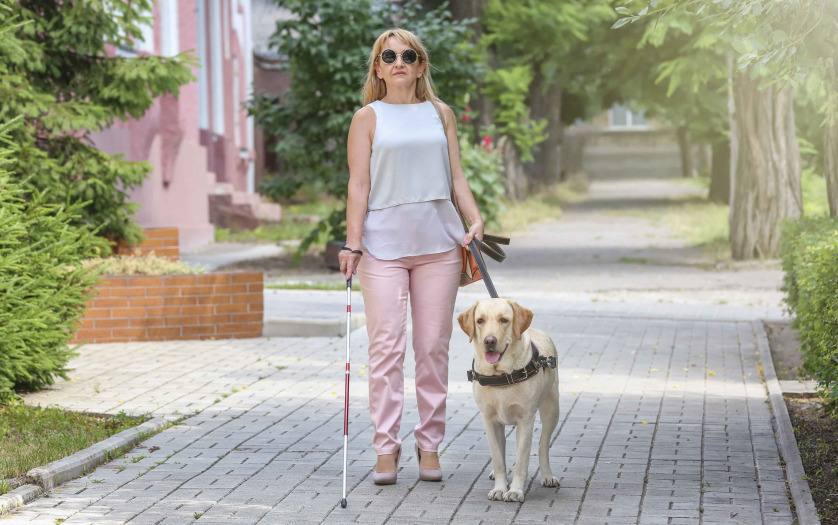
New Zealanders with vision disabilities are waiting five or more years for access to an assistance dog that would give them independence and provide crucial daily aid.
Assistance Dogs NZ Trust (ADNZT) is calling on the New Zealand public to help reduce this long wait time and bring this much-needed solution to the 47 children and families on their waiting list, launching their Appeal Week today.
While they offer support for any disability, they found that in particular there was nowhere for people with disabilities such as autism spectrum disorder, down syndrome and cerebral palsy to access a public access dog. 90% of their clients are now children on the autism spectrum.
Recent research has shown that those with an assistance dog were found to have significantly better psychosocial health, meaning better emotional, social and work/school functioning, compared to those with similar disabilities without a dog. In addition, the dogs often impact their owner in ways that extend beyond what they are directly trained for.
The five year plus waiting list comes down to a lack of resource; the Trust doesn’t receive any government funding, and is funded solely by generous donations, grants and individual donors.
Chair of Assistance Dogs NZ Trust, Sinaed Horgan, explains that, “if we can increase our funding, we’ll ultimately be able to look at recruiting more dog trainers, so we can breed more puppies and train more dogs to be placed and reduce this waiting list.
“In part, the waiting list is five years long as we don’t have a cut-off for the list; if an Assistance Dog is a great fit for someone with a disability, we want to make sure they are on the list.”
The hard cost of training and placing an assistance dog is $75,000, which is Assistance Dogs NZ Trust’s fundraising goal for this appeal. Each client is asked to fundraise $20,000 toward their dog, which they often achieve with creative fundraising efforts while also covering large medical bills and full or part-time care.
The Opie family, whose daughter Sienna has an assistance dog named Rocco, have seen their investment quickly paid back based on the development and progress Sienna has made since Rocco joined their family just over a year ago.
Sienna has 15Q24 micro-deletion syndrome and is the only person in New Zealand with this condition, one of just a few hundred cases in the world. Sienna’s genetic deletion is accompanied by seizures, ADHD, sensory processing disorder and global development delay.
While having experienced innumerable surgeries in the first five years of her life due to the medical complications the syndrome has caused, Sienna now only has a lung condition and feeding tube remaining. The greatest challenges they now face are behavioural and developmental, and this is where Rocco has the most impact.
The Opie’s went on the waiting list when Sienna was two years old, and five years later Rocco was trained and placed with them.
“In our view you’re better off investing in kids’ treatment early, both to mitigate more intensive treatment later and enhance critical development goals early,” says Tim Opie.