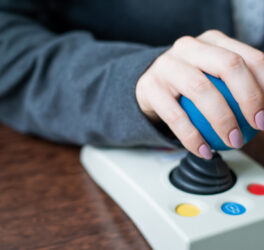
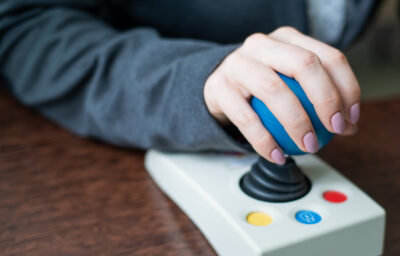
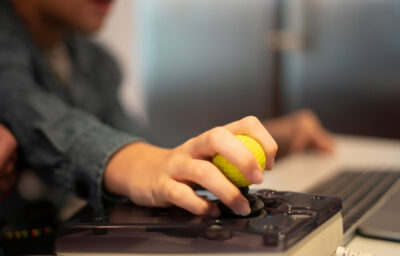
Movement disabilities after strokes and other neurological injuries are among the most common causes of long-term disability in the United States. Thanks to a $700,000 grant from the National Science Foundation, a group of Michigan State University researchers are working on ways robot-assisted learning can help patients improve common daily activities.
“Motor disabilities are extremely common in many neurological injuries, and disabilities in the hand can lead to difficulties in performing activities like reaching and grasping,” said Rajiv Ranganathan, assistant professor in the Department of Kinesiology and a co-principal investigator of the grant. “By using soft robotics to assist and modify these movements, we can complement current therapeutic approaches, potentially providing a way to accelerate rehabilitation.”
Rehabilitation of neurological injuries typically requires re-learning complex motions of a number of joints in the body. Common rehab approaches like instruction and visual feedback are usually not effective for these types of movements, so this project will use robots to apply forces to joints in the hand as a way to help learn complex movement patterns. This research has a range of applications beyond just rehabilitation. It can also help with skill training for athletes, robot-assisted surgery and collaborative human-robot manipulation.
The multidisciplinary project includes the lead principal investigator Vaibhav Srivastava, assistant professor of electrical and computer engineering. The combined expertise in motor learning, computational modeling, robotics and controls will result in a rigorous framework for human-robot learning through physical interactions.
The project aims to discover how to provide physical assistance using a soft robotic glove to facilitate motor learning of hand and finger function and will lead to the development of a novel soft-robotic glove that can sense finger movements as well as provide physical assistance. Associated algorithms that facilitate efficient robot-assisted motor learning will also be developed and calibrated using human motor learning experiments, Srivastava said.
An added benefit for patients using a robotic glove is portability.
“Robotic rehabilitation assistants can be used anywhere and anytime,” Srivastava said. “Aiding rehabilitation of complex motor functions such as finger function are hard even in a traditional setting. The ability to provide assistance at the level of finger joints and its potential societal impact would be very satisfying.”