Students at NIU’s College of Engineering and Engineering Technology and College of Education have developed a solution to help people with vision disabilities gain more mobility as their senior design capstone project.
Professor Gaylen Kapperman, of NIU’s College of Education who is blind himself, presented a challenge to the students to see if they could come up with a solution to help people who are blind better navigate through their environment.
“Humans do not have the ability to walk in a straight line, whether seeing-abled or blind,” said Kapperman. He said that there are currently only two guiding solutions for people with blindness: guide dogs and canes.
Each solution has its drawbacks. Canes require quite a bit of training and orientation to use effectively. Guide dogs can be effective but require extensive care and feeding and are costly. Because of this, only about 2% of people who are blind use guide dogs, according to the website guidingeyes.org.
“And neither of these solutions can keep someone from hitting their head on a low-hanging branch,” said Kapperman.
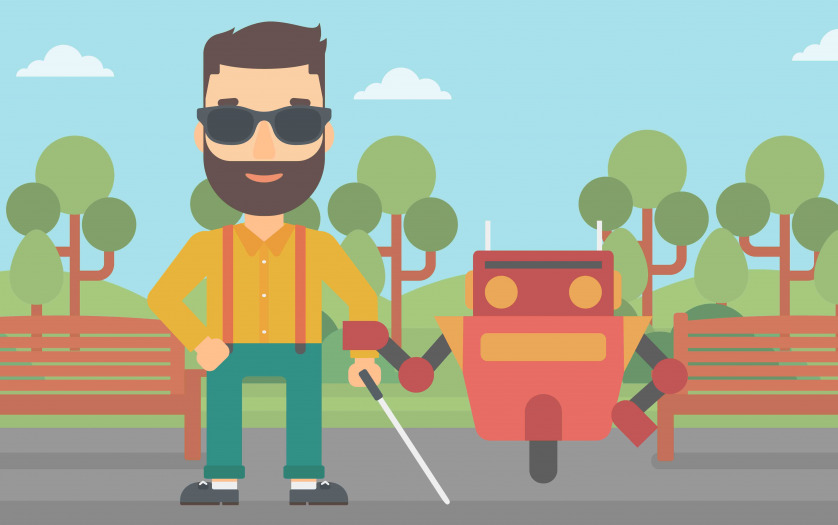
His challenge to the senior design team was this: develop a guiding device that requires no training or care. He described a device that could help the user find the shortest route to their destination using GPS, tell the user where they are, what’s ahead, and if there are any obstacles in their path. His ideal device would also be able to sense curbs or stairs and tell the user to step up or down – so the device would need to be light weight enough to be carried up or down stairs, too.
“I’ve been so impressed with their progress,” said Kapperman.
The team would have had a prototype made if the COVID-19 stay-at-home order had not been put into place.