Top of page
Technology

Wearable Robotic Exoskeleton Could Help People with Multiple Sclerosis

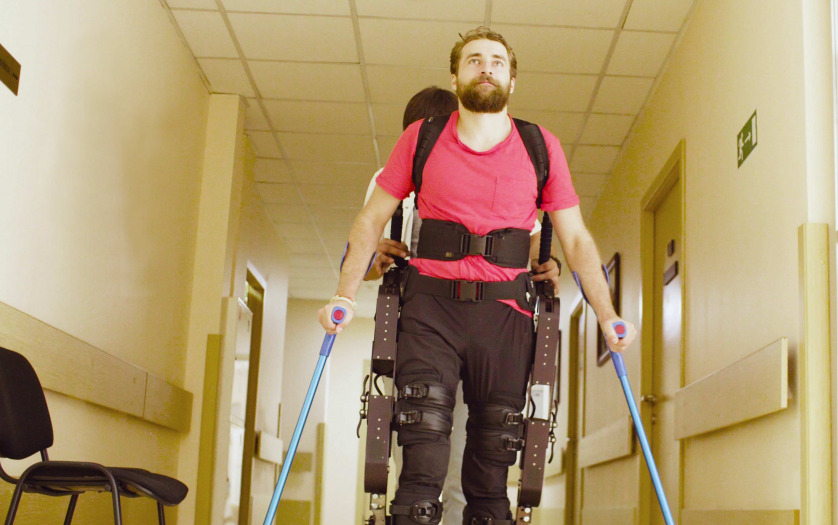
Young disable man in the robotic exoskeleton

UK scientists are to investigate whether wearable robots could help people with multiple sclerosis get more exercise.

Dr Siva Nair and his team at Royal Hallamshire Hospital in Sheffield will examine how powered exoskeletons – or robotic suits – might improve physical fitness in people with mobility issues caused by multiple sclerosis.

Research suggests people with MS should do moderate exercise for 30 minutes, three times a week. But many can find this difficult due to symptoms caused by the condition.

‘We all know how important exercise is,’ says Dr Nair. ‘A lack of it can cause heart disease, stroke, diabetes, obesity and depression. So we need to find a way to make it easier for people with advanced multiple sclerosis to take part in physical activity. Robotics is the natural step forward. By embracing this technology we are giving people who can’t walk the chance to exercise like everyone else.

‘We understand it’s not every day you see someone in a robot suit, and society might need to adjust to such a weird and wonderful sight. That’s why we’re also going to be observing the personal implications of keeping fit in this way – including whether the person wearing the exoskeleton feels it’s an accepted way to exercise.’

You might also like

Close up of a woman hand on adaptive mouse using computer Close up of a woman hand on adaptive mouse using computer

Program expands assistive tech access for persons with disabilities

Persons with disabilities in Western Australia will get better access…

Close up of a kid hand on adaptive mouse using computer Close up of a kid hand on adaptive mouse using computer

Solomon Islands expands AT support for children with disabilities

When thinking of schoolchildren, you would imagine them as being…

Nihal Patel, a second-year medical student, in the The Workshop in James Branch Cabell Library Nihal Patel, a second-year medical student, in the The Workshop in James Branch Cabell Library

Student uses 3D printing to create custom assistive devices for disabled people

On any given night, you can find second-year medical student Nihal Patel in…

Multiple sclerosis MS book and prescription and pen. Multiple sclerosis MS book and prescription and pen.

New test improves early diagnosis of multiple sclerosis

Cerebral-spinal fluid (CSF)-based molecular tests can reliably distinguish multiple sclerosis…