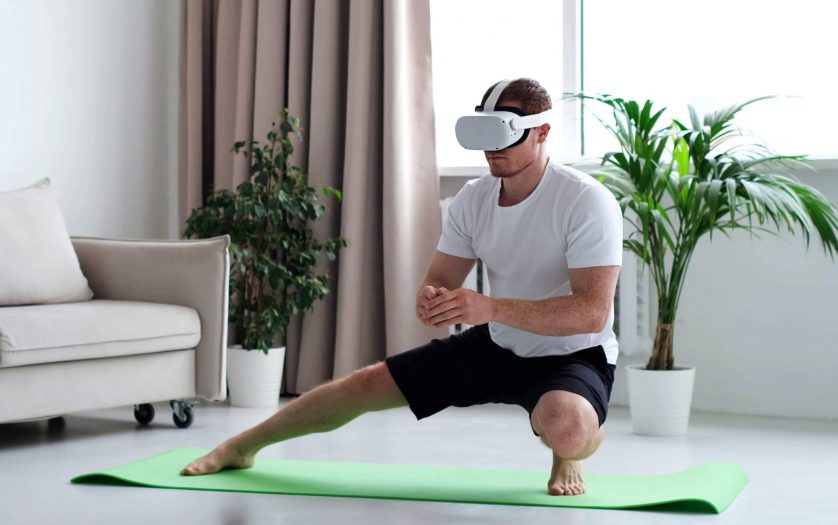
Boosting exercise is often on the agenda in the new year, but if you’re struggling to stick to a new fitness regime, University of South Australia research shows that virtual reality (VR) will not only make exercise feel easier but also ease chronic pain.
Using a novel bike system, researchers found that when people combine VR with cycling, their exercise enjoyment increases by 20% and they exercise for 15% longer.
Importantly, for patients with chronic pain, the technology distracts them from their condition, enabling them to engage in exercise and improve their recovery.
In Australia, exercise guidelines recommend that people exercise for 30 minutes at least three to five times a week. Yet statistics show that only one in five people actually achieve this.
There are 3.4 million people living with chronic pain in Australia. Globally, one in five people struggle with chronic pain.
“Being active is essential for people to stay physically and mentally fit and healthy, but it’s also incredibly important for helping people both recover from injuries and manage chronic conditions such as arthritis,” says PhD candidate Erin MacIntyre.
“We also know that exercise can play an important role in rehabilitation, often reducing pain and disability.
“But the challenge is that there are often barriers to exercise – many find it boring, or say that it requires too much effort, or can be painful. So, we’ve been looking at ways to help overcome these barriers.
“In our study, we combined VR with cycling, so when a rider started exercising with the VR headset on, it made it seem like they were riding in a digital countryside.
“We found that the VR experience distracted cyclists from the exertion of exercise and made the exercise feel easier, which together contributed to increased enjoyment and engagement.”
The study used a stationary bike system with a head-mounted VR display. The system was wirelessly linked to a bespoke VR program that allowed for remote control of the stationary bike’s resistance, as well as the ability to record how hard participants were working (power output in watts). Participants rode the VR bike for up to 30 minutes but were able to end their session early for any reason.
Senior researcher, Assoc Prof Tasha Stanton, says the VR bike system offers a safe, valid, and credible intervention for improving exercise engagement in clinical settings.
“This is a great first step for exploring VR in clinical settings. Our preliminary findings demonstrate the effectiveness of VR to improve both engagement and enjoyment of exercise, even in people who are experiencing chronic pain.
“While more research is needed, we are confident that VR will be more broadly adopted to support health and rehabilitation goals.”