Next-generation exoskeleton technology developed by SFU researchers is poised to offer people with mobility disabilities a new chance at free and independent movement.
The state-of-the-art robotic exoskeleton known as XoMotion is the result of a decade of research and the product of an SFU spin off company, Human in Motion Robotics (HMR) Inc. The company has recently garnered millions in investment, an overseas partnership and a suite of new offices in Vancouver.
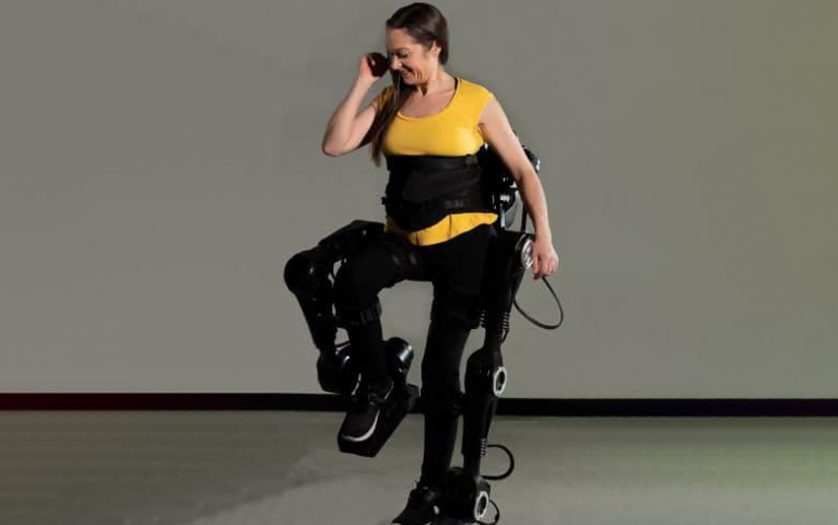
XoMotion allows people with mobility disabilities to stand up and walk on their own, without additional support. When in use, XoMotion maintains its stability and simultaneously encompasses all the ranges of motion and degrees of freedom needed for users to self-balance, walk, sidestep, climb stairs, crouch, and more.
Sensors within the lower-limb exoskeleton mimic the human body’s sense of logic to identify structures along the path, and in-turn, generate a fully balanced motion.
SFU professors Siamak Arzanpour and Edward Park, both researchers in the School of Mechatronic Systems Engineering, began work on the device in 2014 with a vision to enhance exoskeleton technology and empower people with mobility disabilities to have more options for movement.
“We felt that there was an immediate need to help people with motion disabilities to walk again, with a full range of motion. At the time, exoskeletons could only walk forward. That was the only motion possible,” says Arzanpour.
The SFU professors, who first met in 2001 as graduate students at the University of Toronto, co-founded HMR in 2016, bringing together a group of students, end-users, therapists, and organizations to build upon the exoskeleton. Currently, 70 per cent of HMR employees are SFU graduates.
Through a mutual connection at SFU’s Surrey Campus, Arzanpour and Park were introduced to Chloe Angus, a Vancouver-based fashion designer who was diagnosed with an inoperable benign tumor in her spinal cord in 2015 which resulted in a sudden and permanent loss of mobility in her legs. At the time, doctors told Angus that she would need a wheelchair to move for the rest of her life.
Years after her diagnosis, XoMotion is helping her defy all odds.
Angus quickly became a key member of the HMR team by working as an end-user to test the exoskeleton first-hand throughout its stages of development.
“The first time I walked with the exoskeleton was a jaw-dropping experience,” says Angus, who has since accepted a role as HMR’s Director of Lived Experience. “After all these years, the exoskeleton let me stand up and walk on my own without falling. I felt like myself again.”
“Without Chloe and her inspiration, we wouldn’t be here today. Her contributions to our success are monumental,” says Arzanpour, who envisions the technology to one day be available as an assistive option in public settings, such as malls.
In recent years, HMR has garnered multiple streams of investment, including a contract with Innovative Solutions Canada, and $10 million in funding during their Series A round in May, including an $8 million investment and strategic partnership from Beno TNR, a prominent Korean technology investment firm.
“When I look back and see how far we’ve come, I can say that it wouldn’t have been possible without our amazing team,” says Arzanpour. “Everyone here believes in our mission and sees themselves as part of the progress and success of Human in Motion Robotics.”