Honda Motor announced a new firm called Ashirase, Inc. It’s the first startup that came from Ignition, Honda’s new business creation program.
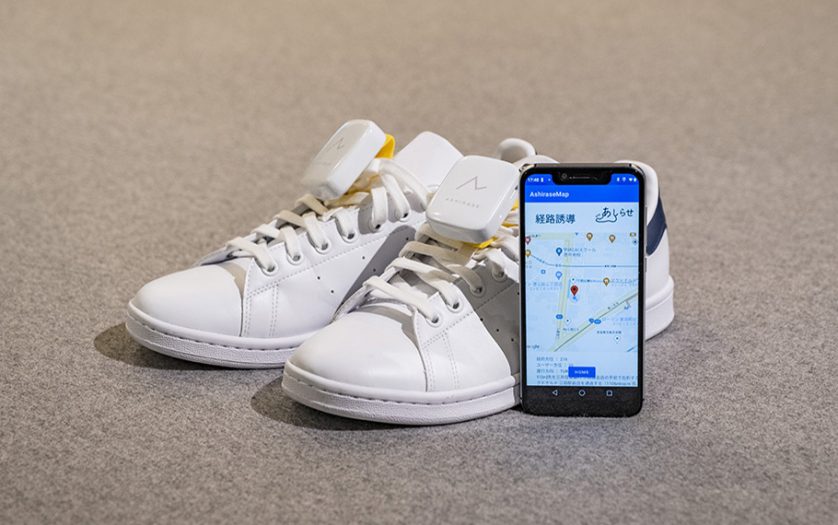
Ashirase, Inc. is currently developing an in-shoe navigation system to support people with vision disabilities with walking and will strive to begin sales of the system, also named “Ashirase,” before the end of the fiscal year ending March 31, 2023.
The Ashirase is a navigation system consisting of a smartphone app and a three-dimensional vibration device including a motion sensor, which is attached inside the shoe.
Based on the route set with the app, the device vibrates to provide navigation. When the user should go straight, the vibrator positioned on the front part of the foot vibrates, and when the user is approaching a right or left turn, the vibrator on the right or left side vibrates to notify the user. The navigation provided by Ashirase enables intuitive understanding of the route, and therefore the user does not have to be constantly mindful of the direction, which makes it possible for the user to walk more safely and with a more relaxed state of mind.
Key features of Ashirase:
- Guidance information for the visually impaired user is generated based on GNSS positioning information and data based on the user’s foot movement.
- Navigation is provided through vibration on the foot, so as not to interfere with the user’s hand which is holding a white cane, or ears used to listen to ambient sounds.
- Vibrators are located aligned with the nerve layer of the foot, making it easy to feel the vibration.
- Soft material that maintains its original shape is used for the device in order to limit any discomfort to the user.
In Japan, the number of people with vision disabilities including low vision was estimated to be 1.64 million as of 2007, and the number is forecast to increase to nearly 2 million by 2030*3.
People with vision disabilities constantly check their safety and route to the destination when they walk alone. However, as they are required to use all remaining senses to acquire information to compensate for their limited sight, it is somewhat inevitable that they will be unable to pay thorough attention and face functional issues such as “getting lost” or “falling into unsafe situations.” Moreover, discovery sessions conducted by the development team with the visually impaired revealed that such functional issues lead to psychological issues, as indicated by comments such as:
“I feel frustrated when I remember the time when I was walking freely without vision problems.” (comment by a person with low vision)
“When I get lost, people around me sometimes do not respond when I try to talk to them. It is scary because I don’t know why they are not responding.” (comment by a person with late-onset total blindness).
With the concept of “navigation which enables safety and a relaxed state of mind for the visually impaired,” Ashriase is being developed as a product which helps the users reach their destinations safely and have a more independent lifestyle.
“An accident suffered by one of my family members motivated me to take action to realize safer and more free mobility for people with vision disabilities. I developed the Ashirase and applied to IGNITION, Honda’s new business creation program, which led to the establishment of Ashirase, Inc. I am sure that we will face many obstacles as we work toward the market launch of Ashirase; however, we will overcome such obstacles one by one and devote ourselves wholeheartedly to realize the freedom of mobility for visually impaired people.” Said Wararu Chino, Representative Director of Ashirase, Inc.