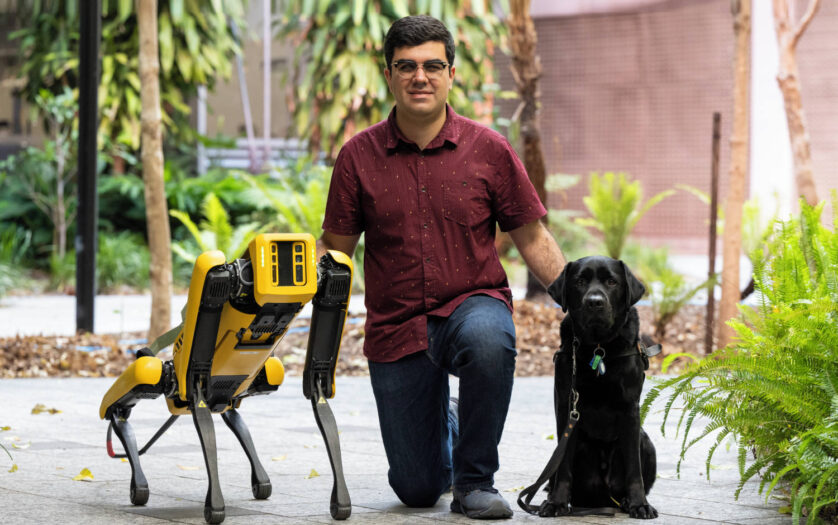
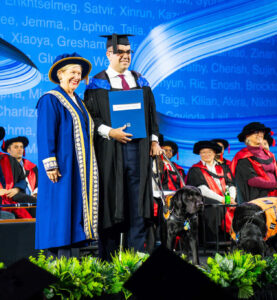
Among the more than 3000 QUT students graduating last week was Santiago Velasquez Hurtado who graduated with a Bachelor of Electrical Engineering (Honours) and his beloved guide dogs, Lockie (retired) and Trey, at his side.
An established entrepreneur, innovator and in-demand speaker by age 29, Santiago’s host of life experiences from taking the Kokoda Challenge (twice) to being invited to speak three times at the United Nations Convention on the Rights of Persons with Disabilities (CRPD) and founding two tech companies, make an astounding resume for anyone, even more so because Santiago is vision-impaired.
During his studies, Santiago used his electrical engineering expertise to found Hailo and develop the Hailo system to enable vision-impaired commuters and other travellers to use public transport by electronically notifying drivers they want to catch a specific bus.
“Hailo will be launching soon, as a world first in a major Australian city. They have also received investment from an international investor. Details will become public over August,” Santiago said.
His second company EyeSyght is developing technology to enable vision-impaired people to feel graphical information in real-time.
For his honours thesis, Santiago worked on another way to empower vision-impaired people to be on the move – the adaptation of a robotic dog, Spot, to be a Guide Dog. He has now handed Spot on to future students to add improvements while getting a feel for being real-world developers.
With all these experiences, Santiago was well-placed for the Churchill Fellowship which last year took him to 11 countries in Europe, Asia, the UK and USA to investigate how those countries’ tackle public transport accessibility, including vehicle manufacturers’ approach to vehicles for people with disabilities.
He’s now writing a book on his findings and how we can improve in Australia, although ‘nothing was wow!’, Santi feels that there were some elements of systems that could be adapted for use in Australia.
“I found some countries were culturally aware of issues a person with disability faces in negotiating a city and its transport system but didn’t have the infrastructure to support it,” he said.
“On the other hand, some had great infrastructure such as audio announcements, level access, and braille signage but were over cautious and took an approach of ‘don’t do that’, ‘don’t try that’.”
Whatever Santiago does next, it will be with the attitude he once said in a TEDX talk: “I’m not disabled because of my lack of sight, I am disabled because the sighted world said so.”