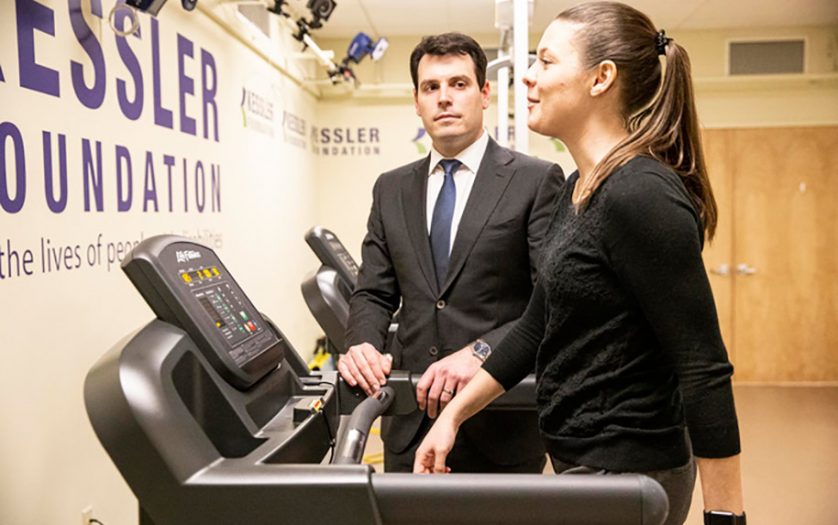
A team of experts encouraged ongoing investigation of the benefits of exercise training for individuals with multiple sclerosis, citing shortcomings of available studies. They outlined their outlook for this avenue of research in, “Exercise in multiple sclerosis,” published in Lancet April 20, 2022.
The authors are Brian Sandroff, PhD, of Kessler Foundation, Robert W. Motl, PhD, of the University of Illinois Chicago, V. Wee Yong, PhD, from the University of Calgary in Canada, Gary R Cutter, PhD, at the University of Alabama at Birmingham, and Gavin Giovannoni, MD, from the Queen Mary University of London, Barts and The London School of Medicine and Dentistry in the UK.
Team members countered the conclusions of recent reviews, which stated that exercise training is not associated with neuroprotection in individuals with multiple sclerosis. Evidence suggests that exercise can prevent or reverse existing and measurable neurological damage or decline, asserted team members. They also suggest that available studies are few and poorly designed and should not discourage ongoing research in this promising field.
Shortcomings cited by the team include patient selection (lack of measurable, pre-existing central nervous system damage), design of exercise regimens (too-short durations of training protocols/follow up), lack of a-priori neurophysiological hypotheses (failure to consider brain adaptations and regions of interest for neuroprotection), and selection of neuroimaging techniques (overreliance on whole-brain/structural neuroimaging).
“The shortcomings of existing research preclude the rendering of strong conclusions at this time,” said lead author Dr. Sandroff, senior research scientist in the Center for Neuropsychology and Neuroscience at Kessler Foundation. “Only through rigorous study can we explore the promise of neuroprotection for individuals living with multiple sclerosis,” he stressed.
“Advancing this line of research depends upon well-designed, randomized, controlled trials based on our knowledge of focal, exercise-induced neuroprotection, with targeted selection criteria, adequate durations of training and follow up, and appropriate neuroimaging techniques,” he concluded. “That will comprise the future evidence base for assessing the role of exercise training in the management of multiple sclerosis. As an approach that offers low cost, easy access, and few side effects, the potential benefits of exercise for individuals with multiple sclerosis warrant thorough investigation.”