The UK’s leading EV mapping service has found that persons with disabilities have difficulty finding charge points that meet their needs.
A new survey of electric vehicle (EV) drivers has found issues around accessibility for drivers with disabilities in UK.
Zap-Map, the UK’s leading EV mapping service, polls the UK’s 2,200 EV drivers to ask them about their vehicles’ experience. The survey has been running for four years and is seen as the go-to guide for tracking EV driver behaviour and charging patterns for the electric vehicle industry.
This year the company teamed up with Motability, a UK charity that focuses on access to mobility for persons with disabilities, to ask drivers with disabilities about their experiences.
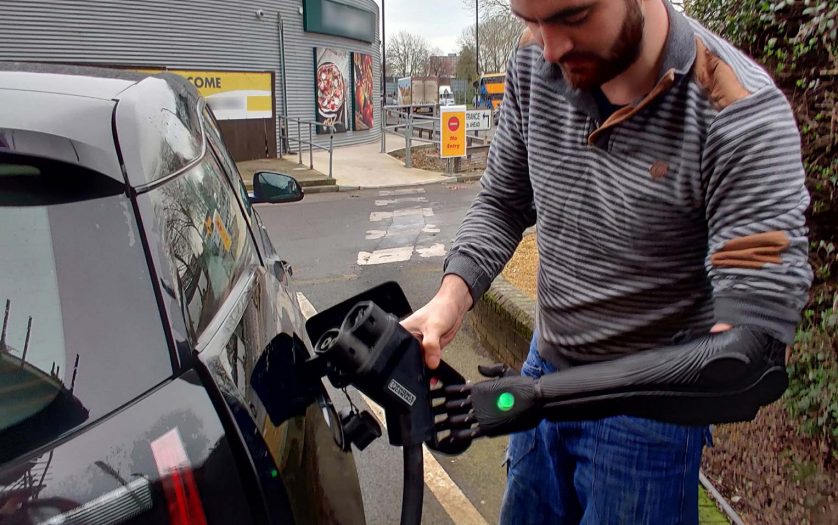
The results found that one-third of disabled people surveyed had difficulties locating a suitable charger that could meet their needs, with one in seven noting their particular challenges with charging cables’ weight.
The survey also revealed that some users experienced difficulties with force required to attach the connector, the lack of dropped kerbs around charge points, and unsuitable parking arrangements.
In addition, 8% of respondents identified as disabled, which is below the 20% rate of disability we expect to see within the UK population. The smaller proportion of disabled people using Zap-Map possibly indicates a more limited uptake of EVs among this group, with accessibility issues being a potential concern.
“The UK is witnessing the start of an electric vehicle revolution with millions of zero-emission cars set to appear on our roads in the near future. The new charging infrastructure to serve those EVs is being built now, and we can’t afford to leave anyone behind. Businesses and charge point operators need to focus more effort on improving accessibility and designing charge points which will benefit everyone” said Dr Ben Lane, Zap-Map’s CTO and Joint MD.
“The results of the Zap-Map/Motability survey should serve as a warning to the industry to sit up and take notice. Many disabled people will be thinking about investing in an electric vehicle but could be put off by a lack of accessibility at public charge point locations.”
“We know that one in five people in the UK are disabled and Motability’s recent would estimate that there will be 2.7 million disabled drivers or passengers by 2035, with 1.35 million expected to be partially or wholly reliant on public charging infra we approach what will be a transformative energy transition in the UK, there is a robust social and commercial case for ensuring that EV charging infrastructure is accessible for disabled people. If we want to work towards a society and economy that is inclusive for all, then accessibility must be a priority.” said Catherine Marris, Innovation Lead at Motability.