Homer narrated in The Odyssey the adventures and misadventures that Ulises lived to return to Ithaca, a place turned into myth and founding fatherland of literature. For those in charge of the Ithaca School of Art and Communication, which aims to help people with disabilities acquire skills for their job placement, this place is not an island in the middle of the Mediterranean but the achievement of stable employment.
“The goal is to get there but also to learn along the way,” says Jordi Navarro, one of the integration consultants in charge of energizing the project. “Hopefully, the journey will be long, and they can learn everything they need by the time they get to Ithaca.”
In collaboration with Obra Social la Caixa, this initiative of the Adecco Foundation has been going on for a year and a half, in which a series of workshops have launched to develop the social skills and competencies of 40 people with intellectual disabilities and mental health problems. The important thing, according to Vanessa Sánchez, the other great person in charge of the initiative, “is to know the person who has the disability, not the disability that the person has because that can lead to bias or wrong prejudice.” In fact, on many occasions,” disability is the least of their obstacles. Their main problems are family-type, with limited financial and training resources available to them, or harassment in the case of women.”
The first workshop they launched, and which has given a letter of nature to the Ithaca School of Art and Communication, was Gigantes, a radio program focused on their job opportunities and an inclusive leisure cultural agenda. The results have far exceeded your expectations:
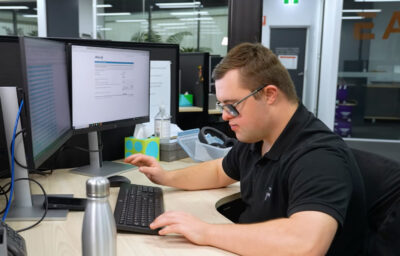
“Last year, we managed to get 15 people to register, and two announcers are no longer here because they are working in ordinary companies, not in special employment centers, ” says Navarro.
But the best proof of success is meeting Paz Gámez, who, despite the first difficulties in communicating, “is the most striking case, because he has undergone a brutal change, especially in self-esteem.” She confirms it herself: “During this year, I have realized that I can do things that I did not feel capable of doing before. I am more sure of myself and my abilities “, something that she has been able to demonstrate in her first work experience at Provivienda, a third sector company that works with people in housing emergencies.
“I feel sheltered and understood, not excluded, as has happened to me in other areas. Here you make friends, and they care about you. I appreciate that love. They do not treat you differently because you have a disability; they treat you like another person after his mental health diagnosis. “At Protagonistas 360, we work on how to face a job interview but also on maintaining the job, which is complicated. Thanks to Jordi and Vanessa, we did not feel as if we were alone in the face of danger.”